

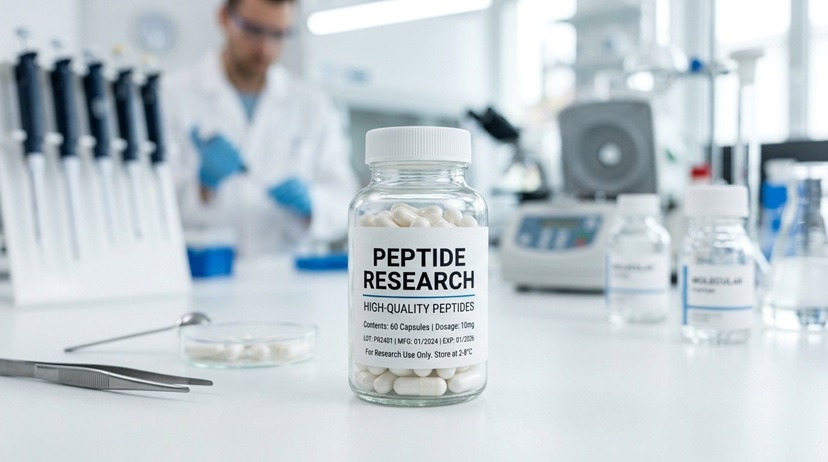
Whether you are reaching for a lyophilized vial, a nasal spray, or a capsule, the format is only half the decision. The other half is quality, and quality signals are what tell you a compound is worth buying no matter which product type it comes in. It is easy to get distracted by format details and forget that a convenient capsule with no documentation is a worse buy than a well-documented vial every single time. This guide covers six signals that apply across every format on peptides.com, so you can evaluate any product with the same lens.
This is written for laboratory research. All products discussed are research use only and not for human or animal consumption.
1. A clearly stated purity figure
Start with purity, because it is the headline measure of what you are actually getting. High-quality research peptides are commonly offered at 99% or greater purity, and that figure should be stated plainly rather than implied. Purity tells you what fraction of the material is the intended compound versus related impurities left behind by synthesis.
This signal applies identically to every format. A vial, a spray, and a capsule should each carry a clear purity figure, because the packaging does nothing to change how much of the contents is the real compound. If a product hides or omits its purity, treat that as a warning regardless of how appealing the format is.
2. A published, batch-specific certificate of analysis
A purity number means little without evidence behind it, and that evidence is the certificate of analysis. A COA is the lab report for a specific batch, and a strong one includes HPLC purity data and mass spectrometry confirming the molecular weight matches the intended sequence. The key words are published and batch-specific. You want a document you can actually open, tied to the lot you are buying, not a generic file that could describe anything.
peptides.com maintains lab reports across its catalog, which is exactly the kind of transparency this signal calls for. Whether the compound is a vial or a ready-to-use format, a real COA lets you verify the contents instead of trusting a label. No COA, no confidence.
3. Independent third-party testing
In-house testing is a start, but independent verification carries more weight because it removes the conflict of interest in grading your own work. Third-party testing from an accredited laboratory confirms that the reported purity and identity hold up under outside scrutiny.
This matters across all formats, and arguably even more for pre-formulated products where you cannot inspect a raw powder. A third-party result on a nasal spray or capsule tells you the finished product genuinely contains what it claims. When a supplier layers third-party testing on top of its own data, you are getting the strongest available evidence, and that layering is a signal of a serious operation.
4. Clear, complete labeling
Labeling is a quiet but revealing signal. A quality product states the compound name and sequence, the quantity in milligrams, the storage guidance, and its research use only status, all plainly. Vague or incomplete labeling suggests either carelessness or something being obscured, neither of which you want in research material.
Across formats, complete labeling also helps you use the product correctly. A vial’s label should support accurate reconstitution, a spray’s label should convey its formulation and handling, and a capsule’s label should state its contents clearly. Consistent, thorough labeling across a catalog, as peptides.com maintains, is a sign that the supplier takes the details seriously.
5. Format-appropriate storage guidance
Because each format stores differently, quality suppliers provide storage guidance suited to the product. A lyophilized vial should come with direction to keep it cold and dry and to manage reconstituted material carefully. A nasal spray should carry instructions for its liquid formulation and usable window. A capsule should note protection from heat and moisture.
The presence of clear, format-appropriate storage guidance is itself a quality signal. It shows the supplier understands how their product behaves and wants you to preserve it. A product sold with no meaningful storage direction leaves you guessing, and guessing is how good material gets degraded before it is ever used.
6. Transparent research-use-only positioning
The final signal is how the product is positioned. A legitimate research peptide supplier describes compounds in chemical and research terms, labels products clearly for research use only, and avoids claims about treating conditions or human use. This transparency is not just a compliance nicety. It is a marker of a supplier operating the way the category is supposed to work.
peptides.com presents itself as a research-use-only source with purity data, published lab reports, and clear research framing across its vials, nasal sprays, and capsules. That consistent positioning tells you the operation is serious about what it is and honest about what its products are for. A seller that blurs those lines is a seller to approach with caution, whatever format they offer.
Applying the six signals
Put together, these six signals form a checklist you can run on any product, in any format. Confirm a stated purity, a published batch-specific certificate of analysis, independent third-party testing, clear and complete labeling, format-appropriate storage guidance, and transparent research-use-only positioning. A product that satisfies all six is a sound buy whether it is a vial, a spray, or a capsule. A product missing several is a poor buy no matter how attractive the format looks. Let the format serve your research question, and let these signals decide whether any given product deserves your trust.
Frequently asked questions
What quality signals matter most when buying research peptides?
A stated purity figure, a published batch-specific certificate of analysis, and independent third-party testing are the core three, supported by clear labeling, format-appropriate storage guidance, and transparent research-use-only positioning. These apply equally to vials, nasal sprays, and capsules.
Do quality signals differ between peptide formats?
The signals themselves stay the same across formats, though how they show up varies. Every format should carry a purity figure, a COA, third-party testing, complete labeling, and suitable storage guidance. The packaging never lowers the documentation you should expect.
Why is third-party testing important for peptides?
Because it provides independent verification of purity and identity, removing the conflict of interest in a supplier grading its own work. It is especially valuable for pre-formulated products like sprays and capsules, where you cannot inspect a raw powder yourself.
This article is for educational purposes and describes how to evaluate research peptide products. All products referenced are for research use only and are not intended for human or animal consumption or to diagnose, treat, cure, or prevent any disease.
Comments are closed.