

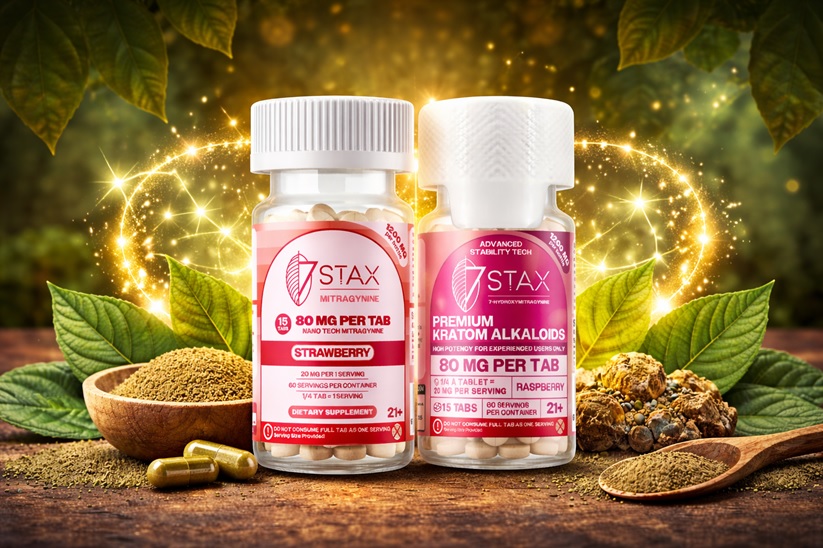
For decades, the conversation surrounding kratom (Mitragyna speciosa) was relatively simple: consumers chose between “Red,” “Green,” or “White” vein powders based on whether they wanted relaxation, balance, or energy.
In 2026, that simplistic view of kratom has been entirely replaced by a deep understanding of botanical pharmacology. The modern kratom market is no longer defined by leaf color, but by specific, isolated chemical compounds namely, alkaloids.
While the kratom leaf contains over 40 different alkaloids, the industry’s focus has narrowed to the two heavyweights responsible for the plant’s effects: Mitragynine (MIT) and 7-Hydroxymitragynine (7-OH).
Understanding the difference between these two molecules is the single most important factor in navigating the 2026 kratom market safely and effectively. This comprehensive guide breaks down the science, potency, and distinct effects of MIT versus 7-OH.
The Baseline: What Are Kratom Alkaloids?
Alkaloids are naturally occurring, nitrogen-bearing organic compounds found in plants. They often have profound physiological effects on humans (caffeine, nicotine, and morphine are all examples of plant alkaloids).
In kratom, the alkaloids interact primarily with the body’s central nervous system, specifically targeting the mu-opioid receptors. These are the same receptors that process endorphins and pharmaceutical painkillers, which explains why kratom is so effective at managing physical discomfort and elevating mood.
However, not all kratom alkaloids interact with these receptors in the same way.
Mitragynine (MIT): The Abundant Foundation
Mitragynine is the undisputed king of the kratom leaf in terms of sheer volume. In a standard batch of raw kratom powder, MIT typically accounts for 60% to 80% of the total alkaloid content.
How MIT Works in the Body?
When you consume traditional kratom powder or a standard liquid extract shot, you are primarily consuming Mitragynine.
Pharmacologically, MIT is classified as a partial agonist at the mu-opioid receptor. This means it binds to the receptor and activates it, but only partially. Because of this partial activation, MIT has a “ceiling effect”, taking massive doses of MIT will eventually stop providing additional pain relief and will instead just cause severe nausea (the “kratom wobbles”).
The Effects of Mitragynine
Because of its unique receptor profile (which also interacts with adrenergic and serotonergic systems), MIT is famous for kratom’s biphasic nature:
- At Low Doses (1-3 grams of powder): MIT acts as a mild stimulant, providing clean energy, enhanced focus, and a mood lift similar to a strong cup of coffee.
- At Moderate Doses (4-6 grams): The stimulating effects fade, replaced by moderate pain relief and physical relaxation.
Potency: Compared to traditional opioids, MIT is relatively weak. Research indicates that Mitragynine is approximately 66 times less potent than morphine at the receptor level.
7-Hydroxymitragynine (7-OH): The Potent Powerhouse
If Mitragynine is the foundation of kratom, 7-Hydroxymitragynine (7-OH) is the heavy artillery.
In nature, 7-OH is incredibly rare. In fresh, raw kratom leaves, it is often undetectable, usually comprising less than 0.05% to 2% of the total alkaloid profile.
So, how does traditional kratom powder provide heavy pain relief if it contains almost no 7-OH? The answer lies in human metabolism. When you consume Mitragynine, it passes through your liver, where specific enzymes (cytochrome P450 3A) oxidize a portion of the MIT, converting it into 7-OH.
In 2026, manufacturers will bypass the liver entirely. Using advanced semi-synthetic oxidation in laboratories, they convert MIT directly into highly concentrated 7-OH isolates, pressing them into tablets and shots.
How 7-OH Works in the Body?
Like MIT, 7-OH is a partial agonist at the mu-opioid receptor. However, its binding affinity (how tightly it locks onto the receptor) is astronomically higher.
The Effects of 7-OH
When you consume an isolated 7-OH product (like a 15mg tablet), the experience is fundamentally different from taking raw kratom powder:
- No Stimulation: 7-OH does not provide the coffee-like energy of MIT.
- Profound Analgesia: 7-OH delivers heavy, full-body pain relief that can break through severe chronic discomfort.
- Deep Sedation: The primary effect of 7-OH is intense physical relaxation and a warm, euphoric mood lift.
Potency: This is where the danger lies. Clinical research from institutions like Johns Hopkins University indicates that 7-OH binds to the mu-opioid receptors with an affinity 13 to 22 times greater than morphine.
7-OH vs. MIT: The 2026 Market Comparison
When choosing between a standard MIT extract and a modern 7-OH product, consumers must weigh their needs against the significant risks.
1. Safety and Tolerance
- MIT: Because of its lower potency and ceiling effect, traditional MIT powder is generally considered safe for daily use (in moderation). Tolerance builds slowly, and withdrawal symptoms are typically mild (similar to caffeine withdrawal).
- 7-OH: Because 7-OH is exponentially stronger, tolerance builds incredibly fast. Daily use of 7OH tablets will quickly render standard kratom powder ineffective. Furthermore, physical dependence on high-dose 7-OH is severe, with withdrawal symptoms mimicking those of traditional pharmaceutical opioids (body aches, insomnia, intense anxiety).
2. Regulatory Scrutiny
- MIT: While the FDA has long been critical of kratom, raw powder (MIT) remains legal in most states and is protected by Kratom Consumer Protection Acts (KCPAs) in over a dozen jurisdictions.
- 7-OH: In 2026, 7-OH is the primary target of regulators. The FDA has recommended Schedule I classification for concentrated 7-OH, and several states have already banned synthetically isolated 7-OH or capped its concentration at 2% of total alkaloids.
Conclusion: Which Alkaloid is Right for You?
The evolution of the kratom market in 2026 has given consumers unprecedented control over their botanical experience.
If you are seeking a daily supplement for mild energy, focus, and moderate discomfort, Mitragynine (MIT) remains the safest, most sustainable, and most affordable option.
However, if you are an experienced user dealing with severe, acute pain that traditional powder cannot touch, 7-Hydroxymitragynine (7-OH) offers unparalleled, fast-acting relief. But this immense power requires immense respect. 7-OH should be treated as a highly potent, situational tool, not a daily supplement and should only be purchased from transparent, AKA GMP-certified brands that provide batch-specific lab testing.
Frequently Asked Questions (FAQs)
Q: Is 7-OH synthetic?
A: 7-OH occurs naturally in the kratom plant in trace amounts. However, the highly concentrated 7-OH found in 2026 tablets and shots is typically “semi-synthetic,” meaning laboratories use chemical oxidation to convert natural Mitragynine into 7-OH at scale.
Q: Can I take MIT and 7-OH together?
A: Yes. In fact, many premium brands in 2026 offer “Full Spectrum” extracts that blend a high dose of MIT with a precise, elevated dose of 7-OH. This provides the energetic foundation of MIT with the heavy pain relief of 7-OH (the “entourage effect”).
Q: Why does 7-OH build tolerance faster than MIT?
A: Because 7-OH binds to the brain’s opioid receptors with an affinity up to 22 times greater than morphine, it causes the receptors to downregulate (adapt) much faster than the weaker MIT molecule.
Q: How do I know if my kratom has 7-OH in it?
A: In 2026, reputable vendors provide a Certificate of Analysis (COA) via a QR code on the packaging. This lab report will explicitly list the exact percentage or milligram count of both Mitragynine and 7-Hydroxymitragynine in the product.
Comments are closed.